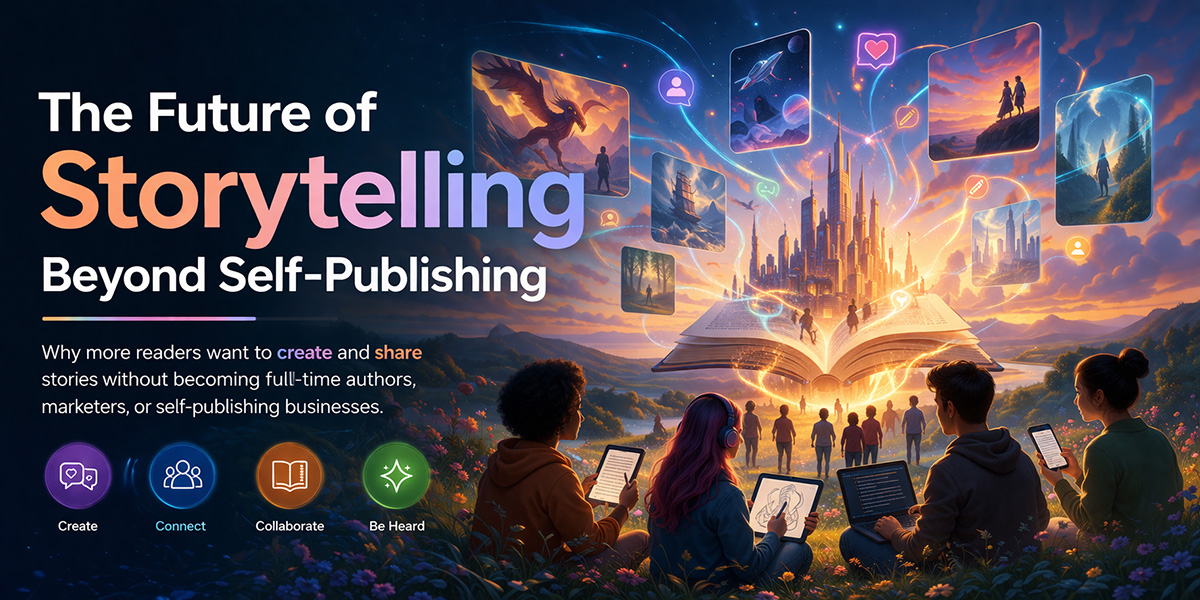
The Future of Storytelling Beyond Self-Publishing
Why more readers want to create and share stories without becoming full-time authors, marketers, or self-publishing businesses.
There is a peculiar assumption lurking beneath a lot of publishing advice, and especially a lot of self-publishing advice.
It goes something like this: if you want to tell stories, then naturally you must also want to become a small business.
Not just a writer, obviously. That would be far too straightforward. No, you must become a brand. A publisher. A marketer. A content engine. A list-builder. A data analyst. Possibly also a part-time graphic designer and reluctant expert in keywords. You may begin with a vague dream of writing emotionally resonant fiction and end, three years later, arguing with a dashboard about click-through rates.
This is presented as liberation.
And, to be fair, for some people it genuinely is. Some authors want exactly that. They want scale, leverage, systems, ad stacks, backlist strategy, and neat little revenue ladders. They are not just writing books. They are building a commercial machine, and some of them are very good at it.
Fine. Excellent. May their read-through be strong and their CPC merciful.
But not everyone who gets into storytelling wants to become a publishing mogul.
In fact, I suspect quite a lot of people get into storytelling because they like stories, which sounds obvious until you spend too long in online author circles and begin to wonder whether fiction was merely a regrettable side effect of newsletter strategy all along.
I say this as someone who has written five novels myself. I am not standing on the sidelines, loftily denouncing an industry I’ve never touched. I know the process. I know the appeal. I know how seductive it is to feel you are building something real when you package a book, publish it properly, and send it out into the world.
I also know how quickly “I want to tell stories” can turn into “I seem to have acquired six jobs, none of which are storytelling.”
Write the book. Edit the book. Commission the cover. Write the blurb. Pick the categories. Optimise the metadata. Upload the files. Build the website. Grow the mailing list. Create the lead magnet. Learn the ad platform. Monitor the numbers. Tweak the copy. Reassess the release cadence. Read a thread from someone making six figures and briefly consider becoming the kind of person who uses the phrase “content funnel” without irony.
This, we are told, is what serious authors do.
And maybe it is. But it is not what all storytellers want to do.
A great many people do not want an author empire. They do not want to become a personal brand with a release calendar. They do not especially want to treat every creative impulse as the first stage of a product pipeline. They want to imagine things, shape them into stories, share them, and have someone somewhere care.
Which is where the standard publishing conversation starts to look strangely narrow.
Even in self-publishing, which prides itself on breaking away from old gatekeepers, the mental model often remains surprisingly traditional. The machinery is different, but the assumptions are familiar. You create a finished book product. You distribute it through the recognised digital storefronts. The reader finds it there, buys it there, consumes it there. Author on one side. Reader on the other. Retail platform in the middle. A respectable little triangle.
It works. I am not pretending otherwise.
It is also no longer the whole picture, and hasn’t been for quite some time.
Because while many authors have been diligently trying to work out whether they should be wide, exclusive, rapid release, slow build, newsletter-first, TikTok-native, direct-sales, or all of the above before collapsing quietly into a cup of tea, storytelling has been mutating elsewhere.
Not disappearing. Mutating.
Wattpad, Royal Road, AO3, fanfiction communities, serial fiction platforms, social reading spaces, comment-driven discovery ecosystems: these are not minor footnotes to the “real” world of books. They are evidence that huge numbers of people are already engaging with stories in ways that do not fit the old industrial model at all.
And what they reveal is rather inconvenient if you are attached to the neat idea that authors make stories and readers consume them from a safe and respectful distance.
Because readers are not behaving very much like passive consumers anymore.
They are following stories as they unfold. Commenting chapter by chapter. Recommending hidden gems to one another with evangelical intensity. Hunting by trope, vibe, subgenre, emotional payoff, fandom, pacing, and very specific micro-tastes that would make a traditional bookstore shelf weep softly into its signage. They are gathering in communities where discussion is part of the experience, not an optional afterthought. They are helping stories spread socially, not merely purchasing them as isolated products.
And then there is fanfiction, which really should have ended this debate years ago.
If you want proof that the border between reader and creator is largely fictional, look at fanfiction. Readers do not simply read and leave. They continue. They remix. They reimagine. They rewrite endings, deepen side characters, pair people up, unpair them again, transplant worlds, splice genres, and generally behave like people who were never content merely to consume. The whole culture of fanfiction rests on a truth the formal publishing world has never quite known what to do with: readers often want to participate.
Not all readers, of course. But enough of them to matter enormously.
And not just in fandom either. More broadly, there is a very large class of people who love stories intensely, have ideas constantly, and would like to bring those ideas to life, but who do not especially want to apprentice themselves to the entire apparatus of modern authorship. They may not want to spend years learning prose craft to a professional standard. They may not want to become marketers. They may not want to spend their evenings researching retailer algorithms like Victorian scholars poring over forbidden manuscripts.
They just want to tell stories.
This is the part I think many self-publishers still underestimate.
They correctly see indie publishing as an alternative to traditional publishing. What they often fail to see is that there are also alternatives to the entire publish-and-retail paradigm itself.
That sounds more radical than it is. The evidence is already everywhere. There are millions of people reading stories in social ecosystems, serial ecosystems, fandom ecosystems, mobile reading ecosystems, creator-reader ecosystems. There are readers who are not really “book shoppers” in the conventional sense at all. There are people who want immediacy, participation, community, abundance, weirdness, specificity, emotional directness, and the joyful chaos of discovery outside the neat shelves of the online bookstore.
The world of storytelling has become much larger than the old map.
Some authors have noticed. Many haven’t.
And this is one of the reasons I’m building StorySparx.
Because I think there is a substantial group of people who are badly underserved by the current model. People with imagination, taste, obsessions, genres they adore, stories they want to see, combinations they cannot find, emotional itches they want fiction to scratch. People who do not necessarily want to be authors in the traditional professional sense, but absolutely do want to create.
The old answer to that person is essentially: well, become an author then.
Learn the craft. Write the manuscript. Edit it. Package it. Publish it. Market it. Build your brand. Build your list. Learn the platforms. Compete for attention. Good luck.
Which is a bit like telling someone who says “I’d love to cook more” that they should open a restaurant, hire staff, master accounting, build a supplier network, and launch a social media strategy.
Some people will do that. Most will sensibly back away.
StorySparx is built around the idea that storytelling deserves a broader set of doorways.
Not everybody who wants to create stories wants the whole author-business package attached. Not everybody wants to train for the commercial Olympics of modern self-publishing. Some people want expression, experimentation, connection, readers, community, and the pleasure of seeing an idea become something real.
That is not a lesser ambition. It is simply a different one.
And I think the market has been strangely slow to take it seriously.
There are already countless signs that readers want more than consumption. They want to comment, share, recommend, react, shape, extend, remix, and increasingly create. They want stories to feel more alive, more social, more immediate, more tailored to their tastes. They want access to a wider, wilder creative landscape than the conventional retailer model tends to foreground.
StorySparx is my attempt to meet that reality head-on.
A place where readers can become creators more easily. A place where the boundary between the two is treated as permeable rather than sacred. A place where telling stories does not require first signing up to become a fully operational publishing enterprise. A place built not around the assumption that everyone wants to build a brand, but around the idea that many people simply want to make something imaginative and share it.
I do not think this replaces authors. I am one. I care about books. I care about craft. I care about writing well.
But I also think we need to be honest.
The old author-reader model is looking a bit antique now. Charming in places, certainly. Worth preserving in some forms, absolutely. But no longer sufficient to describe what is actually happening.
Storytelling is no longer confined to bookshelves, digital or otherwise. It is sprawling out across communities, platforms, fandoms, feeds, comment threads, mobile habits, niche discovery loops, and creator ecosystems. It is becoming more participatory, more social, more chaotic, more specific, and more open to people who would never have described themselves as authors in the old sense.
That is not a threat to storytelling.
That is storytelling doing what it has always done when technology and culture shift: escaping the box it was previously put in.
Not everyone wants to be a publishing mogul.
Some people just want to tell stories, share them, and skip the part where they have to become an email marketer with opinions about ad attribution.
Frankly, I think there are rather a lot of them.
And I think the future may belong to them more than we realise.